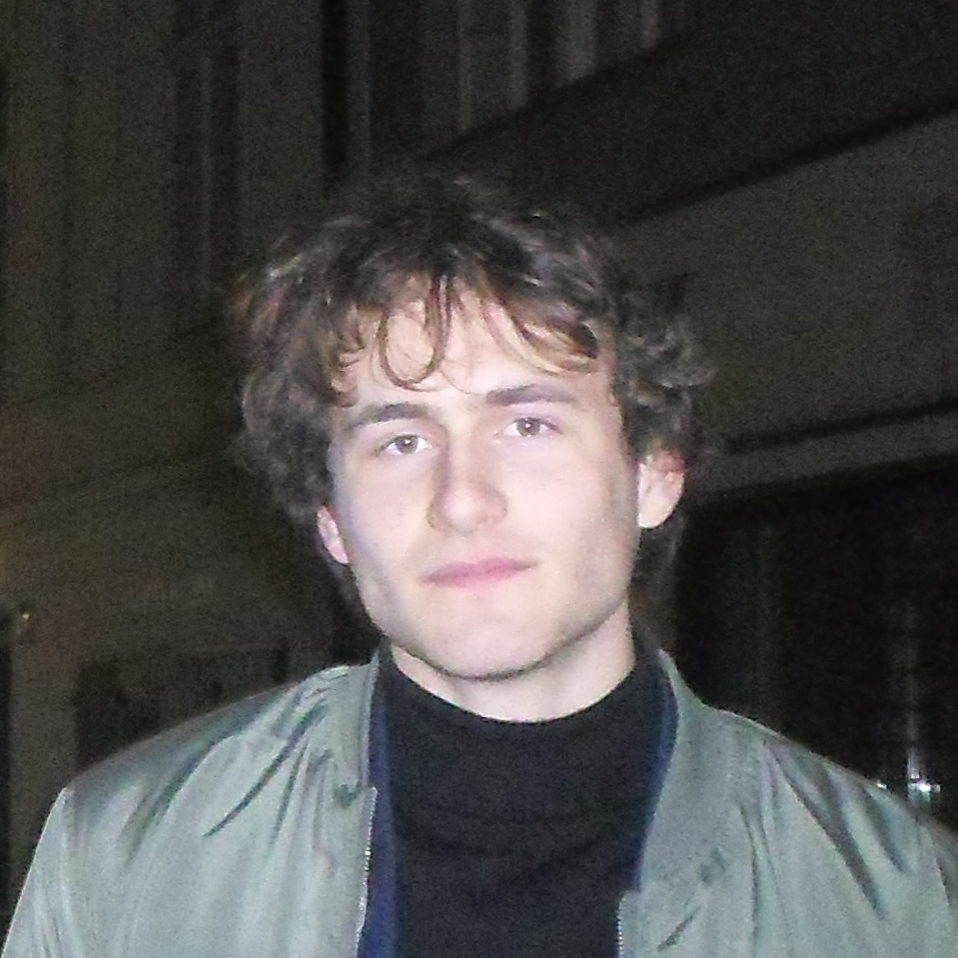
Name Surname
City
party
topic
because your indifference decides things too
Over 70 % of young people aren't interested in local elections. Yet this is where you have the best chance to make your mark.
Local elections are the best opportunity to make young people's lives better in concrete ways. City halls can support more affordable housing, the development of culture and places to spend your free time, modern public transport or greener public spaces.
But if only a quarter of people under 30 turn out to vote, cities will keep focusing mainly on older generations. That also lowers young candidates' chances of standing up for the interests of their peers.
Because most voters stay passive, every young person's vote carries huge weight. All it takes is showing up and turning city hall's priorities towards the future.
Indifference is when the place you live bugs you, but you let others make the decisions about it. Yet local politics affects your everyday life more than the Chamber of Deputies or Prague Castle. With low turnout and hundreds of elected seats, you have a huge chance to actually influence the result or even run successfully yourself. The average councillor is 48. Want young people's views to be represented too? Local politics is where you have the best chance to make that happen.
No need to read long articles: on Instagram we regularly keep you up to date on what's happening in local politics and how the municipal elections are going, so you don't miss a thing.
Follow our IG stories and posts: that's how you'll get how local politics works and easily pick your candidates too.
Follow us on InstagramCouncillors approve timetables, public transport fares, new cycle paths and park-and-ride car parks. A problem spot near you? This is the right place to take it.
source: ČSÚ, Ministry of the Interior of the Czech Republic — 2022 municipal elections · youth turnout and attitudes: Ipsos survey for IPPM, August 2026
In municipal elections there's one shared ballot paper. It lists all the groups standing side by side — parties, movements, coalitions, associations of independents and individual independent candidates — with their full candidate lists.
If your municipality is electing, say, 35 councillors, you have 35 votes. You can put crosses anywhere on the ballot — and you can try out exactly how to split your votes on the ballot below.
Only groups above the 5% threshold win seats. The seats are divided among them according to the number of votes (the D'Hondt method). Who exactly takes a seat is decided by the order on the candidate list and by voters' preference votes.
You elect councillors — not the mayor. The newly elected council meets at its inaugural session, and only then does it elect, from among its members, the mayor, the deputy mayors and the executive board. They then run the municipality for four years.
Click the boxes to put crosses in, just like at the polling station. Mark a whole party, specific names across parties, or both — below you'll see what your vote means. For practice, we're voting in a small municipality with 5 councillors — your real town may have as many as 35, but the principle is exactly the same.
Careful: you can mark no more people than there are councillors. More crosses = invalid ballot.
Because nowhere else does your vote carry so much weight. In a small municipality, a few dozen votes can decide who'll spend four years making decisions about your school, your road or your playground. You'll have some influence in national elections too, but nowhere near as much — in local elections your vote isn't diluted by hundreds of thousands of others, the way it is in national elections.
In municipal elections you elect your town's councillors — they deal with pavements, nursery schools and public transport. In regional elections you elect the regional council — second-class roads, hospitals, secondary schools. In parliamentary elections you elect the Chamber of Deputies — laws and the budget of the whole country. Each takes place at a different time and deals with a completely different level of things.
The council is the municipality's highest body — you elect it directly, and it approves the budget and key decisions. The executive board and the mayor are elected from among its members by the council itself, not by citizens. The board then handles the day-to-day running of the municipality between sessions.
In big cities with city districts you get two ballot papers: one for your city district council, the other for the council of the whole city. You vote for both on the same day and at the same polling station.
Always in the municipality where you have your permanent residence — not where you stay during the week for school or work. There's no voter's certificate for municipal elections, so you have to get home to vote. Living abroad? Unfortunately you can't vote through an embassy either (unlike, say, presidential elections) — these are the only elections where there's no way around this.
Ask your municipality for a mobile ballot box — the election committee will bring it to you at home or to the facility you're in. Just call the municipal office before the election.
You just need to turn 18 by the second day of the election at the latest (this year by 10 October 2026). You don't have to be 18 yet — if your birthday comes in time, you can vote.
As many as there are councillors being elected in your municipality — you'll find the number right on the ballot paper that gets delivered to your home.
A combination of a cross for a party and, at the same time, crosses next to specific names from other candidate lists. We explain it in the “You have three options” block in the How to vote section — and you can try it straight away on the practice ballot.
Movements and parties are political entities with permanent registration. A coalition is formed when parties team up on a joint candidate list just for these elections. An association of independent candidates brings people with no party membership together under one label.
You can hand in your ballot without a single cross — it stays valid, your vote just won't be counted for anyone. It's only invalid if you mark more names than there are councillors being elected, or spoil it in some other way.
Yes — all you need is to be 18, have permanent residence in the municipality and the backing of a party, a movement or an association of independent candidates (you can't run on your own). Unlike parliamentary elections, there's no deposit and no need to collect signatures.
To get you to the polls — municipal elections decide more about the things around you than you'd expect, and this is where your vote carries the most weight of any election. We want to explain it to young people clearly, not lecture them. And we want to make young candidates under 30 more visible, as they often get lost in the anonymity of big parties.
We're an independent non-profit project with no ties to any political party — more about us in the About us section. The website makes no profit and nobody buys advertising through it.
They're based on data from the Czech Statistical Office and results on the volby.cz portal (Ministry of the Interior of the Czech Republic) from the 2022 municipal elections — turnout, the number of municipalities and councillors, and their average age. Young people's attitudes (8 in 10 want to vote, turnout among under-30s only 20–30 %, not knowing the candidates as the main reason) come from an Ipsos survey for the Institut politické participace mladých (IPPM) — a representative sample of 1,223 people aged 18–75, collected online on 17–21 August 2026.
Sure — email zajem@nezajem.cz and tell us what you enjoy and how much time you want to give. There's always a place for you, whether it's writing, graphics or spreading the word.
Send us your question along with your email so we can get back to you.
Election calculator
More than half of the youngest voters say they'd vote if they knew the candidates. So get to know them: respond to 18 statements about your town and see which young candidates see things the way you do.
Like “public transport should be free for people under 26” or “blue parking zones should be expanded”. For each one, just agree, disagree, don't know.
Young candidates from your town answered them before you. No guesswork – it's answer against answer.
Candidates ranked by how many answers you have in common. Each one with a name, party and profile, so you know who to look for on the ballot.

An interactive game about what it's like to run your own city and make decisions about it.
in the works coming soonA debate between several candidates in your regional capital — live and without political soundbites, in partnership with BoldNews.
14 cities pick yours →Find candidates in your town or region. The database keeps growing.
Open the map →A few questions, no political science. Find out which candidate thinks like you do.
Start the calculator →Candidate debates in regional capitals cost money. The fact that they happen is also thanks to FANY Gastroservis.
The partner has no influence over the content, the choice of candidates or the debate questions.
All partners → scan it in your banking app
Transparent account
Debates, the website and materials all cost money, and even a small donation helps. Anyone can look at every incoming and outgoing payment on our account — just as openly as we publish our partners.
NEZÁJEM is a non-partisan, independent, non-profit educational project about the 2026 municipal elections.
We show people what role municipal elections play in everyday life.
We want young people in particular to understand how local politics works, and we want more different voices than before to be heard when the future of municipalities is being decided.
We focus on candidates under 30, who often get lost on long candidate lists.
Are you running? We'll gladly introduce you factually and without any partisan judgement: who you are, what you want to change in your town and why. Just fill in the form in the Candidates section.
Are you from the media and need information, a comment or an interview? Please contact us at zajem@nezajem.cz.
Want to help take NEZÁJEM further as a volunteer? Get in touch at nezajem.cz/pridej-se.
And if you have a tip or some feedback, write to us at zajem@nezajem.cz.

Patrik Michálek
Project leadership
Coordinator for the South Moravian Region
patrik.michalek@
Marie Salvetová
Project leadership
Coordinator for Prague, Central Bohemian Region
marie.salvetova@
Matouš Liščák
Project leadership
Council simulation for secondary schools
Coordinator for the Vysočina Region
matous.liscak@